
Turning an overlooked tax cost into a client benefit
This is the third article in our series on how withholding tax recovery differs by investor type. Following our articles on pension funds and endowments, and hedge funds, we turn to wealth managers, financial advisors, RIAs, sharing how withholding tax recovery impacts the investment returns of the high-net-worth individuals and family offices they serve.
A measurable benefit for wealth managers in a crowded field
For wealth managers, demonstrating value is essential to winning new clients and retaining existing ones. With more than 32,000 investment advisory firms registered with US regulators in 2025, finding meaningful ways to differentiate a firm’s services matters.
Withholding tax recovery is often an untapped way advisors can demonstrate value. When a client owns shares of a company domiciled outside the United States, the source government typically withholds tax at a high rate on any investment income. Depending on the market and the investor’s circumstances, some (or all) of that tax may be recoverable thanks to double taxation treaties between pairs of countries.
The recoverable opportunity can be larger than clients expect. Switzerland, for example, withholds 35% on dividends, while a qualifying US individual is generally entitled to a 15% treaty rate. Certain tax-exempts are entitled to recover all of the funds withheld. Our dividend withholding tax rate database shows statutory and favorable rates across a number of common jurisdictions.
For clients with meaningful foreign equity holdings, recovering excess withholding can boost their annual ROI. It can also help advisors demonstrate tangible value beyond investment performance, potentially offsetting the cost of advice.
Why recoverable tax often goes unclaimed
Recovering excess foreign withholding tax is rarely simple. Depending on the market, demonstrating eligibility for a preferential tax rate (for US residents) requires a certificate of US tax residency (IRS Form 6166), country-specific forms, and evidence of the dividend and tax withheld – all submitted before the applicable deadline. Gathering the documentation requires coordination with the custodian, and advisors and clients often have no clear place to turn for guidance on navigating the nuanced requirements.
Account statements rarely make the opportunity obvious. Firms report foreign withholding in different ways, and a line item showing foreign tax withheld rarely indicates how much of that amount, if any, could be recovered. As a result, reclaim opportunities can go unnoticed.
Another common assumption is that foreign tax credits already address the issue. But the credit generally only applies to foreign tax that is owed after exhausting all available treaty or local-law relief. Tax that is eligible for a refund generally does not qualify for the credit, even if the investor never files a reclaim. For high net worth clients, whose returns can draw scrutiny, ensuring that foreign tax is addressed correctly is an important part of managing their affairs.
For some accounts, the foreign tax credit is not available at all. Foreign tax withheld on dividends inside an IRA generally cannot be claimed as a foreign tax credit. Tax-exempt charitable investors may likewise have no US tax liability against which to apply a credit. For these investors, a source-country reclaim may offer the only route to recovering excess tax.
Which clients are good candidates
A portfolio made up entirely of US companies, however large, has nothing to recover.
The natural starting point is identifying clients with direct holdings of foreign equities, including ordinary shares and American Depositary Receipts (ADRs), then assessing the beneficial owner’s tax residence and account type.
Three factors help determine whether a portfolio warrants further analysis:
- Holdings: Direct investments in foreign equities may present recovery opportunities, including ADRs traded on US exchanges. For mutual funds and ETFs, recovery on underlying foreign holdings is generally pursued at the fund level rather than by individual shareholders.
- Investor and account type: Eligibility depends on the beneficial owner’s tax residence, the account structure and the rules of the source country. In some markets, qualifying tax-exempt investors are entitled to lower rates than taxable investors (or full exemption). Although demonstrating eligibility can require additional documentation, as US tax-exempt status does not automatically confer equivalent treatment abroad. IRAs, charitable accounts and taxable accounts may all be treated differently.
- Markets: Potential recoveries vary by country, depending on the statutory withholding rate, the rate available to the investor and the dividends received.
Widely Held Markets: What a Taxable US Individual May Recover
Tax-exempt investors may be eligible for exemption in all markets listed, except France.
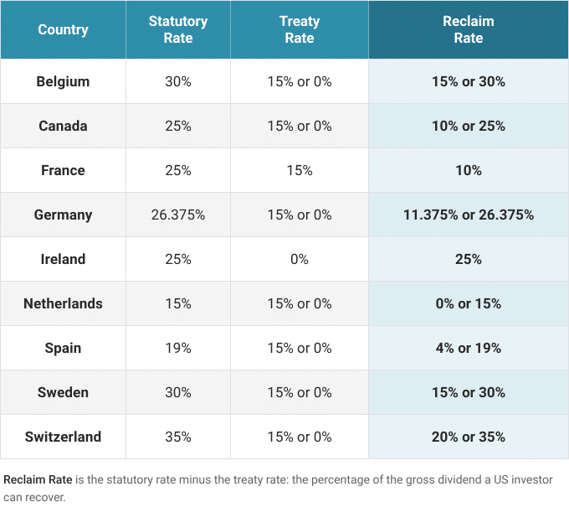
Illustrations for qualifying taxable US individual investors, based on our 2026 dividend withholding tax rate database.
Portfolio size also matters because every claim involves documentation and processing costs. GlobeTax maintains position studies showing the minimum holding needed in commonly held securities for a claim to be economically viable, which help advisors quickly identify which accounts warrant further analysis.
Prior years and other common concerns
Recovery opportunities often extend beyond the current year. Every market sets its own statute of limitations, and in many markets, claims can be filed for dividends paid several years earlier. Clients who have never pursued a reclaim may therefore be able to recover tax on past dividends as well as future ones.
If foreign tax credits were already claimed, the client’s tax preparer should review the implications before submitting reclaims, including whether adjustments are necessary. In the meantime, advisors can explore arrangements to address withholding on future dividends.
Some clients are understandably reluctant to send personal information to a foreign government. Explaining why it is needed can help: the tax authority must verify the claimant’s identity and eligibility for a refund. Also note that information-sharing agreements between governments and taxpayer privacy rules govern how the information is handled.
The administrative burden need not fall entirely on the advisor or client. Working with a specialist can help manage the documentation, filing and follow-up required to pursue a claim.
How GlobeTax works with investment advisors and wealth managers
For an individual client, an advisor can submit the portfolio to GlobeTax for a position-level analysis that identifies the holdings and markets with potential recovery opportunities.
For a firm, GlobeTax can analyze a book of accounts and rank opportunities by potential recovery value. Advisors can then prioritize outreach on the clients and accounts where recovery may have the greatest impact.
Custodians and broker dealers enrolled in GlobeTax’s MIDAS service are able to deliver a comprehensive service to account holders that includes relief at source, quick refund, and standard, post-payable reclaims. Advisors should ask their firm’s tax operations or asset servicing team whether this capability is already in place.
Recovering excess withholding gives advisors a clear benefit they can show clients, one that can strengthen relationships and help them stand out in a crowded field. For advisors whose clients hold meaningful direct investments in foreign equities, the first step is understanding what is recoverable.
GlobeTax can analyze a single client portfolio or an entire book of business to identify which accounts qualify and which claims are closest to expiring. Request a custom analysis.